
UK Inflation Outlook: Bank of England Says Current Risks Mirror 2011 Trends
- Editorial Team

- Mar 16
- 5 min read
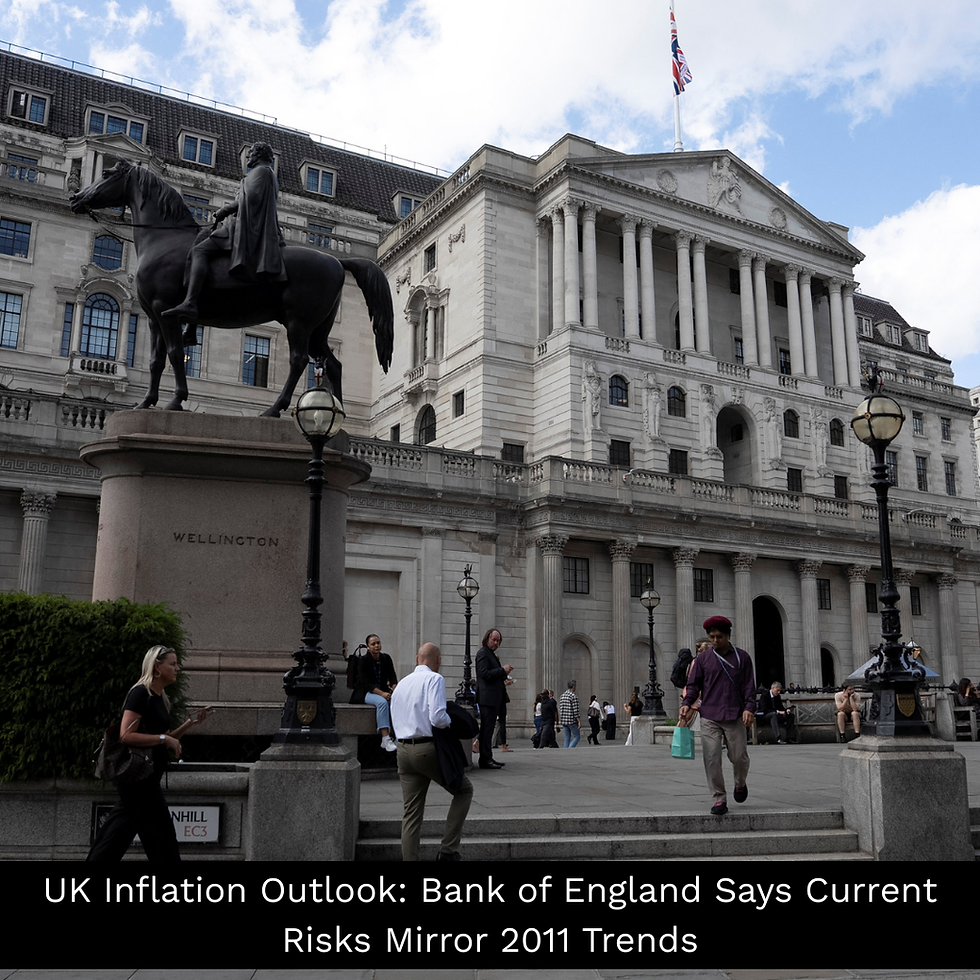
The UK's inflation outlook is starting to look less like the big jump in 2022 and more like the slow, steady rise in prices that happened in 2011. This difference is important for Bank of England policymakers because it shows that inflation may stay stubbornly above target even without the big shocks that caused prices to rise a few years ago.
Recent research by the central bank shows that once inflation hits 3% to 4%, it is very likely to stay there instead of quickly dropping back to the Bank of England's 2% target. This makes people worry that inflation could stay high for a long time, which means that policymakers need to be careful when they think about lowering interest rates.
Figuring out why things are more like 2011 than 2022 can help you understand the problems the UK economy is having right now.
Why 2011 Is a Better Year to Compare
Inflation skyrocketed around the world in 2022, mostly because of big shocks around the world. The COVID-19 pandemic messed up supply chains, and Russia's invasion of Ukraine made energy prices go up a lot. These sudden shocks made inflation rise very quickly, to levels that hadn't been seen in decades.
But the UK seems to have a different inflation situation right now. Policymakers are more worried about slow-burning inflation pressures that could keep prices rising slowly but steadily instead of a sharp and short-lived spike.
The UK went through something similar in 2011. Inflation went above the Bank of England's target, but it didn't go up to extreme levels. Instead, it stayed high for a longer time, which made it harder for policymakers to bring it back down.
Some of those things are true about the situation today. Inflation may not go up to double digits again, but it could stay above the central bank's target for a long time.
The Problem of “Sticky” Inflation
Economists call “inflation persistence” or “sticky inflation” one of the biggest worries for central banks. This happens when prices stop going up as quickly but don't go back down to normal levels.
Inflation can make it hard to make policies when it stays around 3% or 4%. If interest rates are cut too soon, inflation could go up again. But if rates stay high for too long, the economy could grow more slowly and borrowing costs for businesses and households could go up.
The Bank of England is worried that inflation will become a permanent part of the economy. When people and businesses start to think that prices will keep going up, those thoughts can affect how they act, like how they negotiate wages and set prices. This makes it harder to control inflation.
Surveys have already shown that the British public still thinks that prices will go up a lot. Long-term expectations have been around 3.7%, which is higher than they were before the pandemic.
These hopes can have a big impact on how prices will change in the future.
Energy Prices Are Still a Big Risk
Energy prices are another important thing that affects inflation in the UK. Because the country gets a lot of its energy from other countries, prices at home can change quickly when things happen around the world.
Recent tensions in world politics have caused energy prices to rise again, which makes people worry that inflation could rise even more. Economists say that rising oil and gas prices could push UK inflation back up to 3% or more by the end of 2026, making it harder to stabilize the economy.
The situation isn't as bad as the energy shock of 2022, but policymakers are still unsure because global energy markets remain volatile.
If energy prices stay high, they could slow down the UK's progress in lowering inflation.
What This Means for Interest Rates
The Bank of England's interest rate policy is heavily influenced by the outlook for inflation. When inflation is high, central banks usually raise interest rates to bring it down. When inflation is under control, they lower interest rates.
But if inflation stays above the target level, policymakers may have to keep rates higher for longer.
Some economists think that the Bank of England will be careful when it comes to cutting interest rates this year. Energy prices are going up, and inflation is still a problem. This could make the central bank put off easing monetary policy.
Predictions say that the Bank of England might keep interest rates the same for now instead of quickly lowering them.
This means that borrowing costs may stay high for a while for both households and businesses.
Policymakers Have a Hard Time Balancing
The Bank of England now has a tough job to do. Inflation has already dropped a lot from the very high levels seen in 2022, when global energy prices caused a major cost-of-living crisis.
On the other hand, inflation hasn't fully returned to the central bank's 2% target, and prices could keep going up.
Policymakers need to find a good balance between two goals that are at odds with each other:
Keeping inflation in check
Helping the economy grow
If interest rates stay high for too long, the economy might not grow as quickly. But if rates are lowered too soon, inflation could start to rise again.
This delicate balancing act has become one of the most important problems that UK economic policymakers have to deal with.
What We Learned From the Past
Policymakers can avoid making the same mistakes by looking back at times of high inflation.
The year 2011 showed that moderate inflation can last for a long time even when there aren't any big economic shocks. During that time, inflation stayed above the Bank of England's goal for a few years. This was partly because commodity prices were rising and the economy was changing.
People in charge of making decisions today know about that history. They want to avoid underestimating the risk of prices staying high by looking at past inflation cycles.
After the events of 2021 and 2022, when many economists thought inflation would be short-lived but later had to change their predictions, central banks around the world have also become more careful.
The Future of the UK Economy
Inflation in the UK will depend on a number of things, such as:
Energy prices
Wage growth
The global economic environment
If energy markets settle down and wage growth slows down, inflation could slowly go back to where the Bank of England wants it to be.
But if shocks around the world or strong wage growth keep pushing prices up, inflation may stay above target for a longer time.
Right now, it looks like the central bank's main goal is to keep inflation from becoming a permanent part of the economy.
The comparison to 2011 suggests that policymakers are getting ready for a longer fight against inflation, even if the big spikes that happened in 2022 don't happen again.
Conclusion
The Bank of England's current problem with inflation looks more and more like what the UK went through in 2011, not the huge shock of inflation in 2022.
The risk now is that inflation could stay moderately high for a long time instead of rising quickly and then falling quickly.
If inflation stays at 3% to 4% for a long time, it will be hard for policymakers to find a balance between economic growth and price stability.
The message is clear for businesses, investors, and families: even though the worst of the inflation crisis may be over, it may take longer than expected to fully bring inflation back under control.


Comments