
From AI to Quantum: The Trillion-Dollar Revolution in Healthcare
- Editorial Team

- Nov 10, 2025
- 4 min read
Updated: Feb 2
Introduction: Technology is Redefining the Future of Medicine
The global healthcare industry is standing at a transformational crossroads.
Once driven solely by human expertise and analog tools, it is now being reimagined by the convergence of artificial intelligence (AI), quantum computing, and biotechnology.
Together, these technologies are not just improving diagnostics or streamlining workflows—they’re creating a trillion-dollar digital healthcare revolution that’s redefining the boundaries of human longevity, precision medicine, and global access to care.
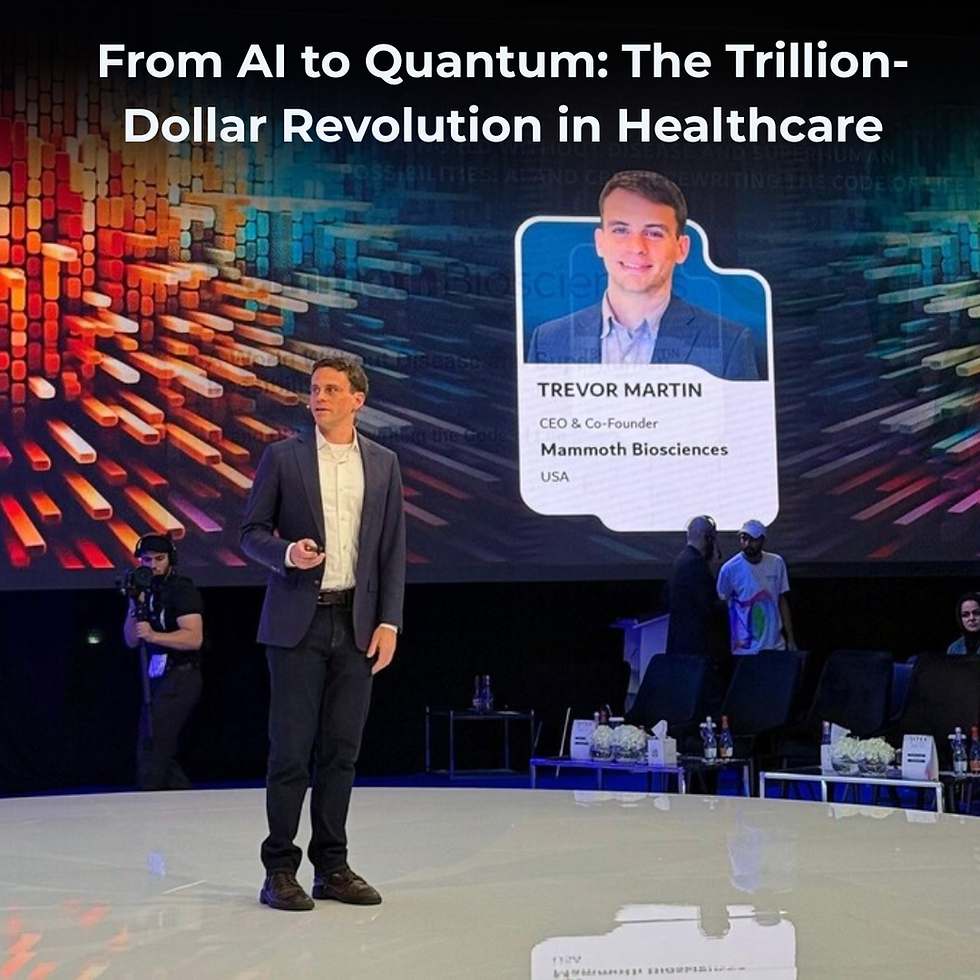
At GITEX Global 2025, the world’s largest technology event, innovators and industry leaders highlighted how the intersection of these forces is propelling healthcare into a new era—one where algorithms can detect diseases before symptoms appear, quantum computers can simulate biological processes in seconds, and biotech breakthroughs can re-engineer life itself.
AI: The Heartbeat of Digital Healthcare
Among all emerging technologies, AI stands at the core of this healthcare revolution.
Artificial intelligence has already reshaped how hospitals, researchers, and pharmaceutical companies operate—reducing human error, predicting patient outcomes, and unlocking insights buried in massive datasets.
AI’s most significant impact is in medical imaging and diagnostics. Deep learning algorithms now rival radiologists in detecting cancers, fractures, and cardiovascular anomalies with extraordinary precision.
AI models are also being used to analyze patient data in real time, allowing for predictive healthcare—where diseases are managed proactively rather than reactively.
Companies like IBM Watson Health, Google DeepMind, and Microsoft Azure Health are leading the charge, helping institutions automate administrative workflows and empower clinicians to focus on patient outcomes instead of paperwork.
As a result, AI is not just a tool—it’s becoming the connective tissue of digital healthcare ecosystems.
Quantum Computing: The Next Frontier
While AI represents the present, quantum computing is shaping the future.
Traditional computers, even the most powerful supercomputers, struggle to process the staggering complexity of biological and molecular interactions. Quantum computing changes that completely.
By leveraging quantum bits (qubits), these systems can process information in multiple states simultaneously, enabling researchers to simulate entire biological systems and predict drug interactions at unprecedented speed.
This leap in computational power could cut drug discovery timelines from years to months, dramatically lowering costs and accelerating life-saving treatments.
At GITEX Global, experts highlighted how quantum computing could make personalized medicine truly attainable. Imagine running millions of molecular simulations to determine which treatment will work best for an individual’s genetic profile—instantly. That’s the power quantum technology promises.
Companies like IBM Quantum, IonQ, and Google Quantum AI are already collaborating with pharmaceutical firms and research institutions to build the foundations of quantum-powered biomedicine.
In the next decade, quantum health simulations could eliminate much of the trial-and-error approach in medical science, opening the door to treatments that are more targeted, faster to develop, and far more effective.
Biotech: Engineering the Building Blocks of Life
Parallel to AI and quantum breakthroughs, biotechnology is evolving into the most profound instrument of human innovation.
From gene editing to synthetic biology, biotech is no longer just a lab science—it’s becoming a data-driven, AI-enhanced industry that directly interfaces with the digital world.
Advancements in CRISPR, genomics, and bioinformatics are giving scientists the tools to modify DNA sequences with accuracy once deemed impossible.
Combined with AI models that can predict genetic variations and disease likelihood, biotechnology is enabling preventive and personalized healthcare at the molecular level.
This synergy between AI and biotech is fueling what analysts now call the BioDigital Era—a future where biological processes are simulated, optimized, and enhanced through computational intelligence.
Quantum computing adds another layer by helping decode molecular complexities that were previously unreachable through classical computing.
The Market Potential: A Trillion-Dollar Revolution
According to data presented at GITEX Global, the digital healthcare market is on track to surpass $1.7 trillion by 2030, fueled by AI adoption, biotechnology innovation, and quantum infrastructure investments.
The integration of these technologies is expected to generate new revenue models, from AI-as-a-Service in healthcare to quantum-driven clinical research and bioinformatics cloud platforms.
Investors and governments alike are taking notice. The Middle East, Europe, and North America are pouring billions into AI healthcare startups and biotech innovation hubs, while Asia is emerging as a hub for medical data analytics and AI-driven hospital infrastructure.
But beyond the economics lies something far more significant — the democratization of healthcare.
Emerging economies can now access technologies that were once confined to top-tier research labs, enabling faster disease detection, affordable treatments, and equitable access to care.
Challenges: Ethics, Privacy, and Human Oversight
Despite its promise, the healthcare revolution carries its own set of challenges. Data privacy, algorithmic bias, and ethical concerns about genetic manipulation remain at the forefront of the debate.
As AI systems become more autonomous and biotech gains the ability to alter life at its core, global regulatory frameworks will need to evolve faster than ever before.
Healthcare leaders emphasize the importance of responsible innovation—ensuring transparency, data protection, and inclusivity in the technologies being developed.
Quantum encryption and blockchain-based data systems are emerging as potential safeguards against the misuse of sensitive health data.
The key will be finding balance: embracing the power of innovation while protecting human dignity and ethical boundaries.
Conclusion: The Convergence Era Has Begun
The convergence of AI, quantum computing, and biotechnology is not a distant possibility—it’s already unfolding.
Together, they’re ushering in a new age of intelligent healthcare, one that promises precision, speed, and sustainability.
This isn’t merely a technological revolution—it’s a biological and digital awakening.
The trillion-dollar question isn’t whether AI and quantum will transform healthcare—it’s whether humanity is ready to transform with them.


Comments